



































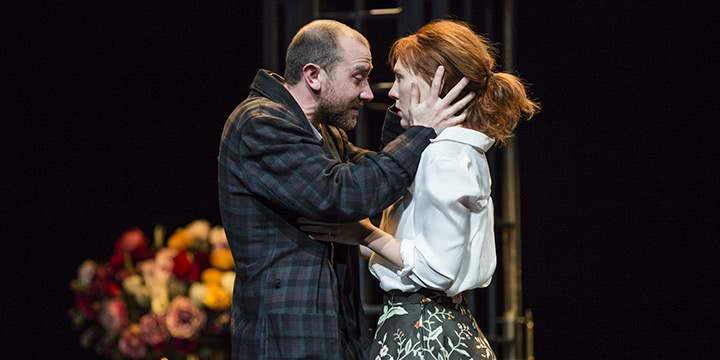

Tradition holds it is the Scottish Play (that is,Macbeth– surely it doesn’t count as bad luck if it’s in writing, right?) that will most likely plague a production behind the scenes, yet Bell Shakespeare’s return to everyone’s favourite moody Dane has recently found its own complications.
Hamlet himself (Josh McConville) has injured his back, and an understudy has stepped up to the plate. While wishing McConville a speedy recovery, for Matilda Ridgway it provides a curious insight into the familiarity and expectations of her doomed Ophelia. When the play’s the thing, it pays not to get too complacent with character.
“Yesterday we had our first preview in Canberra, but because our Hamlet has a back injury we had our understudy on last night. So that changed a lot of things,” Ridgway admits. “We’re waiting to hear if our original Hamlet is going to go on or if he still needs rest. But it’s kind of fascinating. Character is based on your relationships with other people, and how you choose to engage with them. I think those are pretty key things that an audience reads from an actor’s performance, so when one of your primary relationships is changed with a completely different actor, that totally changes how you perform. Their intensity, their speed – it’s really an amazing refresher.
“When an actor doesn’t come in how you’re expecting them to, if they change their intention on a line, that completely rearranges things. It makes you consider, ‘Hmm, what would Ophelia do if Hamlet didn’t respond as she’s expecting?’ because you haven’t been expecting it yourself.”
Already Ridgway’s Ophelia is being applauded for her boisterousness, her sense of modernity and independence. It is not an Ophelia who is meekly led through the machinations of the men around her, although Shakespeare’s text itself does not allow her a great deal of freedom. In devising her role, Ridgway had to establish a fine balance between creating a whole, three-dimensional character – one who seems real and autonomous – while maintaining synchronicity within the world of the play; that Ophelia stands out, yet still weaves in with the characters around her.
“That’s something that was very present in my mind from the beginning,” Ridgway says. “Obviously Ophelia is written in a certain way in a specific time. The play doesn’t pass the Bechdel test. Ophelia as written is quite a functional character. Her relationship to the men in the play dictates who she is, and is the prism through which we see her. But that said, when you’re setting it in 2015, I think it’s really important to think about what an audience is going to get from it. You need to think about why a 2015 audience needs to see it. You want to be able to say, ‘Yes, that is a woman. That is more than a functional finger puppet for the men in the play.’
“For me, it was really important to see how we could push boundaries, to make her someone vivacious, exciting, boisterous, funny. There’s no reason when she walks onstage that we need to fear for her. Can we reach the nunnery stage and have people think, ‘Yeah, there’s the chance that she could change his mind, she could bring him back from the brink’? I hope the audience reaches that point and is at least a little convinced that things could go another way.”
Having launched in Melbourne and travelling to 27 other venues in its run, this production of Hamlet is ambitious to say the least. Directed by Damien Ryan, the perennial favourite has been brought into 2015 but, refreshingly, without the usual contemporisations that can hobble a classic text (no references to celebrities or local council shenanigans here). What is most prescient about the play is its evocation of a state under siege; not necessarily from an enemy abroad, but from an omniscient state of surveillance.
“By having people dress in a way we can understand, to see a world we recognise with social mores and customs we’re familiar with, I think it can hit closer,” Ridgway explains. “It’s definitely an other world, but still today’s world. I think sometimes [with older texts] it’s easy to see them as a presentation, where we’re less culpable somehow; it’s easy to have distance. This [production] seems very pertinent, especially given the legislation that just came in monitoring our internet activity.
“We do live in a world of surveillance, and in this play people are constantly being watched. Hamlet can’t have a meeting with his mother without Polonius being there, Ophelia and Hamlet can’t meet in private without his uncle and her father overhearing. No-one is ever allowed to have a private thought or moment, except for Hamlet and his soliloquies to the audience. Even then, the most famous speech, ‘To be or not to be,’ Ophelia is there onstage and he’s being overheard by Polonius and Claudius.
“That world, that Stasi Germany feeling, definitely informs the play. What’s most fascinating, though, is that while we’re constantly looking towards the Other, this constant fearmongering that the Other is what is going to destroy us, it’s actually the enemy within that brings things down. It is the Prince of Denmark who kills the whole Royal Family, it is the King who has got there by nefarious means. I think that’s also a rather interesting theme to have present here in Australia right now.”
[Hamlet photo by Daniel Boud]
Hamletwill be performed at the Playhouse, Sydney Opera House, Tuesday October 27 – Sunday November 22.