



































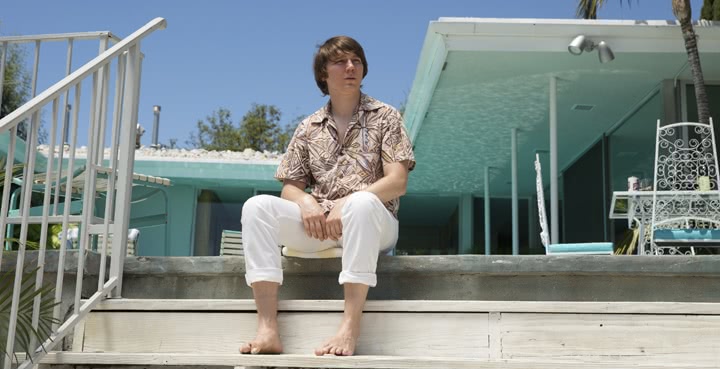

Love & Mercy is a splendid, troubling film for several reasons. It is a tremendous testament to the power and prison of creativity, and does not shy away from the pitfalls of unchecked success. It also features a terrific cast that brings its story to vivid life, with Paul Dano and John Cusack playing the young and old Brian Wilson respectively; Elizabeth Banks as future Mrs. Wilson, Melinda Ledbetter; and Paul Giamatti in particularly unsettling form as Eugene Landy, Wilson’s doctor and insidious warden in later life.
Yet the film is at its most effective when producer-turned-director Bill Pohlad pulls back the curtain to reveal Brian Wilson not as The Beach Boys’ eccentric musical savant, but instead as a deeply unstable man at the mercy of demons real and imagined. It is a story spanning 20 years, and as Pohlad explains, creating this world was no simple task.
“I think you have to suspend reality to a degree,” says Pohlad. “You have to really believe that you can do this, and that your vision and the decisions you’re making are right. Otherwise you’re just going to crumble. So you have to get that ego going and assume it’s all going to be OK. Once you start thinking about showing it to other people, though, the reality starts to sink in – ‘Wait a minute, I don’t know what this thing is!’ [Laughs].
“I’ve been living with it for so long, to me it feels really amateurish, almost like a home movie, and I’m afraid everyone’s going to hate it. Even in early screenings when we got a nice reception, there had been so much emotion building up to it that I didn’t really believe it. I thought someone had made a mistake. It wasn’t until our second big screening [when] I started to think that some people might actually like it.”
The film swings between two strikingly different periods in Wilson’s life, and it is here that Pohlad found his real connection with the story. On one hand we have Wilson at the height of The Beach Boys’ fame, tucked away in the studio obsessively constructing Pet Sounds, an album that would ultimately be regarded as close to genius, yet at the time was seen as a ponderous mistake. On the other we have Wilson two decades later, crippled by mental illness and a virtual prisoner to his 24-hour therapist, Dr. Landy. It is a harrowing, if no less entertaining account of one of modern music’s great composers, and exactly the kind of weighty film you would expect from the producer behind 12 Years A Slave, The Tree Of Life and Into The Wild. Yet the prospect of Pohlad taking time out to relax with a Fast & Furious-style genre piece seems rather thin.
“Ha, well, there are a range of things to be interested in. You try things on. But I don’t know, that’s a whole different zone. I haven’t seen any of those Fast & Furious movies, which is more because I haven’t had the chance to get around to it rather than not being interested. For me, it just feels like if you spend years of your life on a project, you want it to be about something, to hopefully have something that reflects in people’s lives. You want something that might stand the test of time, so you can hope, looking back in ten years, that it all still means something.
“There’s a saying that a director never stops making their movie, they just give up at some point. And though that isn’t entirely true, if I had to go back and reshoot it, there are certainly ideas or thoughts I could still play with. But I think you get to a point where you need to let it go and see what happens.”
Since the initial success of Love & Mercy – complete with Wilson’s own seal of approval – there have already been offers for Pohlad to continue with the biopic mantle and undertake the story of some other troubled musician. They are forever in vogue, after all: Ray, All Is By My Side, I’m Not There, the list whirs on. But much as Pohlad continues to admire Wilson’s music, it was the story stripped of the songs – the collapse, despair and renewal – that proved the greatest allure.
“Some things are better left undone. Like On The Road, for example. The effort was there to make that movie over a long period of time and we almost got involved, but to me, it was somewhat foolhardy to take a book like that and try to make a movie of it. It just feels too risky. I also had that little bit of distance from Brian, as I was more of a Beatles fan, which I think made me handle it in a different way than if I had been so close to it.
“It’s a tough thing. People have talked to me a lot since I’ve been working on Love & Mercy about that very question – ‘Oh, what about this person, what about that person?’ And because I’m a big music fan, sure, it’s tempting. But you’ve got to make sure there’s a story there. For me, the fact that Brian had a true, human story beyond the music was what really attracted me. Of all of the bands that I’ve loved over the years, Radiohead or whatever, in my mind it would be a bad idea to try and make a movie of them just because I love the music. It has to have a story that people can relate to, and mean something even if you take the music away.”
One of the film’s most celebrated strengths is the detail with which The Beach Boys’ recording studio has been reconstructed. We see it on a grand scale – rooms teeming with musicians enthralled to Wilson’s vision – but also stripped back to a single, frightened artist donning headphones to hear the soundscape in his head brought to overwhelming life. Pohlad’s love for this music is clear, yet it is his passion for the forces that shaped Wilson’s songs that gives the film such pathos. You almost suspect that in another life, Pohlad may have become a musician himself.
“I think that’s definitely true of a lot of filmmakers,” he laughs. “I think they’re often frustrated musicians. A lot of musicians are also frustrated filmmakers. It goes both ways. For me, it was really the opportunity to recreate that period in Brian’s life, and not just the music, where there are so many different layers, but the actual creativity that was happening at that time. It was something to really wonder, you know, a creativity to stand in awe of. I just loved that.
“There were times in this movie, and in producing other films, where I’ve felt that way and got on that roll. Things start happening and you’re feeling so good right there; it’s all coming together, it’s going great, you get a real high from it. Yet Brian was doing that on Pet Sounds constantly! So it’s amazing to feel even just a little bit of that.”
Love & Mercy (dir. Bill Pohlad) is in cinemas Thursday June 25.