


































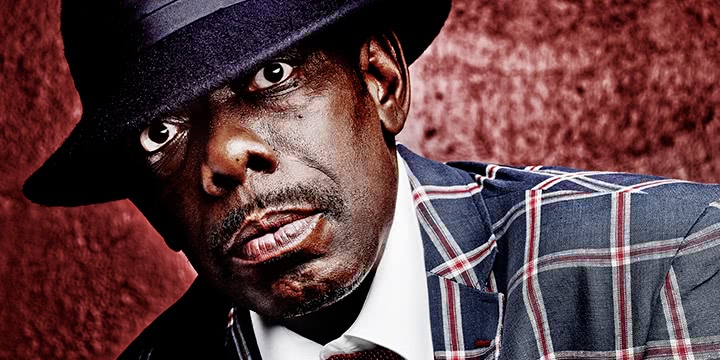

The blues have always been a part of Lucky Peterson’s life. When he was young, his father owned a nightclub in Buffalo that became a regular hotspot for bluesmen touring across the States.
The sounds of gospel, early R&B and gritty guitars surrounded Peterson while he was growing up, so it should come as no surprise that he cut his first album at just five years of age. Clearly, the iconic sounds on which he was raised have never left him – Peterson continues to perform and write music today, maintaining a rigorous touring schedule across the globe.
“I’ve been playing since I was three years old,” he laughs. “Now I’m 51, so I’ve been doing this all my life. Now I’m kind of elevated, so I’ll play blues, jazz, soul, gospel, funk – I think the key thing is to make the hair on your arms that you can’t see rise. You know what I’m saying? Give you those chill-bumps.”
From Peterson’s perspective, the blues and its many derivatives can be tabled any way you want, but at the heart of the genre is the same visceral effect it’s always had. In his eyes, this is – and always will be – what gives meaning to the music he makes.
“First of all, you have to be able to feel it,” he says. “If you can’t feel it deep within – from your heart and from the depths of your soul – then it’s not worth doing. Everything I’ve done in my life, I’ve felt it. I’ve put myself through the test.”
Peterson first made his name with American audiences as a child performing on The Ed Sullivan Show,singing a cover of James Brown’s soul anthem ‘Please, Please, Please’. Brown’s influence has touched many, including a young Peterson, who still cites Brown as the first artist to awaken him to the power of music.
“He was the first person I heard who gave me goosebumps,” Peterson recalls. “‘Make It Funky’; all that type of stuff. Then when I saw him live, that really lifted me up. The only part about that was I thought, ‘Well, I know I can’t dance like him,’ but boy,I wish I could.”
After bursting into music and performance at such a young age, Peterson was taken under the wing of fellow bluesman Little Milton, playing guitar and keyboards in his band. “He was like a father to me,” says Peterson. “I learned how to present yourself to an audience; how to feel the right way. That’s what I learned. I learned the right way how to play the blues and how to read the audience. And that’s the type of stuff I was happy to be around.”
Outside Little Milton’s band, Peterson also developed his chops playing with the likes of Etta James and Bobby Bland. Arguably, it was his years as a hard-working sideman that allowed him to develop his guitar skills to near-virtuosic levels. Peterson never needed to rely on flurries of fast-paced notes – instead, he developed a type of musical intuition; the ability to move with the music before the band had even gone there.
“I let my spirit do that,” he says of his dynamic improvisations. “My spirit will put me there. I work with the spirit and the people, and it will take me where I need to go at the time I need to get there, you know what I’m saying? I don’t force anything; I let everything come naturally. I rely on the audience participation to make me feel good, and when the audience makes me feel good, I want to give back to the audience. That’s what I do.”
After spending much of his life onstage, performance has become second nature to Peterson. As his career becomes less focused on recording studio albums, the live environment is where his music thrives the most. He never feels more at home than when he is armed with a guitar and in front of a crowd. “I feel wonderful. I feel great when I make that connection. I have no problems. And I don’t want any problems, unless a piece of blues decides that it wants to come over my way.”
It’s these same feelings Peterson wishes to impart on his audience: “Peace. Friendship. Love. We’re doing everything out of love,” he says. “That’s what we want – to be able to love somebody and present love, and let it stay like that. My music is very positive. I’m not a sad person at all. Sometimes I can be a cocky person, but I’m not a sad person.”
Peterson has ultimately made it his life’s work to spread his vision of positivity through sound. Now he wants nothing more than to continue sharing it with the world, listener by listener. “I take one day at a time, one moment at a time. I want [audiences] to enjoy my music. I want them to be able to say, ‘If I’m having a bad day and I need some positive inspiration, I need some inspiration to keep on going on,’ I want them to put my music on and I’ll give it to them. That’s what I want. That’s what I live for.”
[Lucky Peterson photo ©JM Lubrano]
Lucky Peterson appears at Bluesfest 2016,Thursday March 24 – Monday March 28, atTyagarah Tea Tree Farm, and also at The Basement on Tuesday March 22.