


































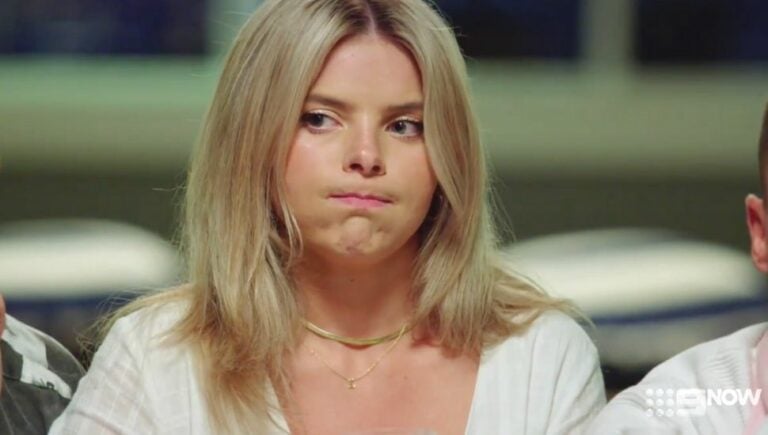

Olivia – who was undoubtedly the reigning villain of season nine of MAFS – has revealed how much she was paid to appear on the show.
The reality star confirmed to the Daily Mail that all the participants were “each paid ‘about $1,100 per week”.
Their accommodation was covered outside of that budget and the stipends were paid to cover living expenses, including food, while filming the show in Sydney.
Olivia’s co-star, and on air rival, Domenica, has previously spoken about how much they were paid for their time, claiming that it was “pretty much minimum wage”.
“I feel like the show does get a bad rap, and I’m not getting paid to say that. Because I didn’t get paid enough, to be honest, with what I went through…” she said during an appearance on The Kyle and Jackie O Show.
Jackie O then asked Domenica how much the cast was paid for their time.
“I think it’s pretty much minimum wage. Look, even [co-star] Dion [Giannarelli] said there wasn’t enough to cover his rent,” replied Domenica.
Love Film & TV?
Get your daily dose of everything happening in music, film and TV in Australia and abroad.

“It’s enough to just cover your rent, your living expenses, kind of thing. Because when you’re living [in the MAFS apartment complex], all of that is taken care of.
“You don’t have to pay for anything. It’s pretty much maybe like an average wage, I would say.”
We’ve previously reported that participants on the Aussie experiment are paid $150 a day – working out to $1,050 a week, which doesn’t sound too shabby. However, it’s practically pennies compared to their NZ counterparts, who are reportedly paid $2,000 a week.
Samuel Levi, who appeared on MAFS New Zealand in 2018 told So Dramatic! that they were paid $285 per day.
“We got paid a weekly wage of $2000 each week, for the number of weeks we are in the experiment for until you had written leave,” he told the publication.
“We also got paid pro-rata for days we came back once it wrapped, for the likes of our final Dinner Party and Reunion episode which was a couple of weeks later,” Levi added.
“I think this was done so we as contestants were 100% in the experiment, and didn’t have to worry about distractions from the outside world… I guess it gave us no reason to feel not needed to have full attention during the show.”
For more on this topic, follow the Film and TV Observer.