


































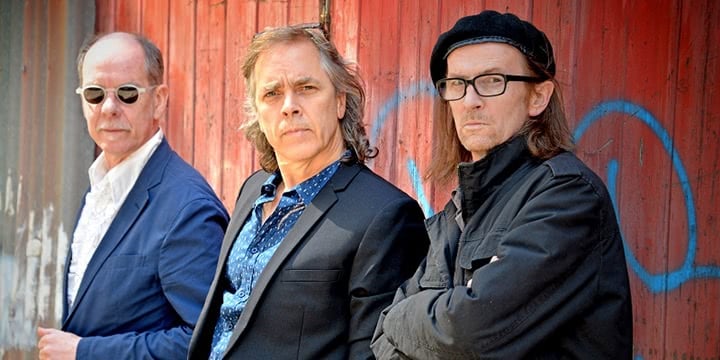

Andrew Duffield is having a pretty good day.
The long-serving keyboard player for Australian new wave chart-busters Models has just been appointed to the board of a not-for-profit organisation called Visionary Images, a charitable group he has been associated with for over a decade.
“I’ve helped them with work in the past,” Duffield says. “It’s about creating public art with disadvantaged and disempowered youth. It’s really tremendous work that they do. I was pleased to be invited onto the board. But gee, what a weird thing that is,” he laughs. “It’s all, ‘I second that motion!’ and that kind of stuff. All these funny protocols and rituals.”
For Duffield, using music to help heal those who need it most isn’t some late-career U-turn. The artist has spent the better part of his life believing in rock’s power to redeem, even if he initially struggles to explain exactly what it all means to him. “I find music hits me on some sort of… I wouldn’t say it’s a transcendental level.” He hesitates. “But it’s, uh… Oh, I dunno. Help me out!”
He tries again. “Over the course of my career … I’ve found there’s an air of vulnerability to musicians. Musicians work in a pre-lingual kind of state. There’s something very ‘early’ [about our] communication. There have been studies done into the life of musicians, and they do die before the general public do. I’m kind of interested in those things.”
Duffield isn’t simply speaking in abstracts. James Freud, the songwriter behind Models’ ‘Barbados’, committed suicide in 2010 after a long battle with alcoholism. The chorus nestled like a snake at the centre of ‘Barbados’ – “I am the voice left from drinking” – wasn’t some kind of tangential poetic rumination. It was the bold truth.
Not that Duffield himself always thinks the strength of a good song necessarily comes from the words. “I’m interested in how music talks to people,” he says. “I’m not saying like a lyric, like a Paul Kelly song. My mind doesn’t work like that. I’ve never been very good at processing lyrics. I’ve tried listening to lyrics and I can’t – I get too involved in the music.”
That mistrust of language is fairly evident across Models’ discography. Though Freud’s songwriting injected a jolting dose of autobiography into the mix, on the whole the band members always seemed suspicious of wearing their hearts on their sleeves, at least in an obvious way. “A lot of the time with Models it’s been a pretty abstract connection between lyrics and the music anyway,” Duffield says. “I particularly love that about Sean Kelly’s writing for the band. It can be particularly obtuse and delicious.”
Such a kind of strange, barely defined creative process means it’s hard for Duffield to pinpoint exactly how songs get written. The processes that formed a track like Models’ 1985 hit ‘Out Of Mind, Out Of Sight’ are natural – like the pressures that turn coal into diamonds. “Rock bands are dysfunctional kind of families, I suppose,” he says. “You all have to coexist and everyone has to communicate their bit. I mean, we all had our strengths and our weaknesses that we were able to bring to the table.”
Models are a democracy, then – they always have been – and Duffield thinks the concept of musical auteurs is ultimately an outdated one. “What you discover is that unless you’re really trying to be tyrannical about it … ultimately the music is going to be the combination of those four people [in the band]. You can stamp your feet all you want and say, ‘I don’t like that drum feel,’ or ‘I don’t like the bassline,’ but it’s not going to ultimately [work]. That band is who they are. They are that group of people.”
Such lessons learnt during his time in the band helped Duffield when he had to go it alone. During Models’ extended periods of silence, has Duffield directed his energy towards other projects, penning jingles and TV show themes. He even crafted the legendary earworm that kicked off each episode of the ABC kids’ show Round The Twist.
“It’s not about language,” Duffield says. “I think [it’s like] football. Anyone can speak about football with equal ability. You might be the most trained sportswriter, but in many ways the opinion of a five-year-old could be as telling of the outcome … Similarly, visuals and music – I think one is attracted to the other. [Soundtracks] and music for advertising are about complementing visuals with sound. So that’s something I’m very attuned to. Doing advertising is a fantastic kind of leveller.
“I had to do work with McDonald’s and Cadbury’s,” he adds. “There are all these people in suits who are used to marketing and outcomes and you have to discuss music with them. And if you can engage them – if you can get them to loosen their neckties a little and stop being their marketing degree – then they can show a bit of passion. [That’s] really interesting.”
Ultimately, it doesn’t matter whether Duffield is writing for Cadbury or the ABC, or Models, or even for himself. Not much distinguishes a jingle from a pop hit or a theme song, anyway – the end result is always the same. “Music is a common language,” he says. “It’s our way of communicating passion without killing each other.”
Models, Machinations and Dave Mason perform onSunday May 29 at the Enmore Theatre.