


































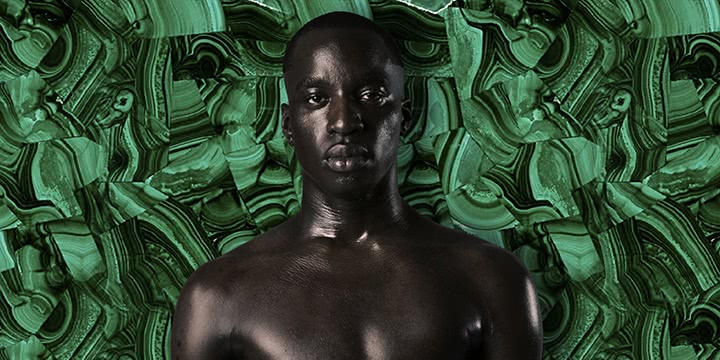

When he’s not making music, Petite Noir goes by the name Yannick Ilunga. Although Ilunga grew up in Cape Town, South Africa, his French stage moniker is a nod to his Congolese heritage.
Likewise the title of his debut full-length, La Vie Est Belle / Life Is Beautiful, which came out last week. The album follows on from January’s The King Of Anxiety EP, which touched on indie rock, trip hop and Afrobeat in a steady, laidback manner. By contrast, the album is forcefully rhythmic, and at times aggressive.
“I’m in a different space at the moment – well, when I was writing the album – than I was when I was writing The King Of Anxiety,” says Ilunga. “They almost have the same kind of emotion – two different sides. One’s more laidback and sweet, the other one’s a bit more harsh.”
If you pay attention to the album’s lyrics, a lot of positive themes emerge, starting with the title of the record that doubles as its opening line. Accordingly, several songs allude to the power of love – the solace and joy that comes from loving each other and loving oneself. However, La Vie Est Belle is not without its darker moments.
“I think the album’s a lot more political,” says Ilunga. “It’s a lot deeper than what we see, what we hear. The lyrics are quite deep. They’re not as literal as The King Of Anxiety.”
The motives of outwardly political music aren’t always blatant. It could stem from a feeling within the artist that something needs to be urgently and immediately expressed, or it could be part of a well-wrought agenda an artist wants to communicate with the audience. In Ilunga’s case, he was directly influenced by his surroundings.
“I’m quite spontaneous when it comes to writing music, so the first thing that comes to my mind, I put down,” he says. “And those were the first things that came into my mind when I was writing the album, which means the political situations are not very good.” He pauses before adding: “It’s related to life as a black man.”
The album was made in London, which has been Ilunga’s primary base for the past few years. But despite living there, it wasn’t just life in London that triggered the political turn in his music.
“I moved there four years ago, but I still come back to Africa quite a bit,” he says. “I’m travelling all the time, so it’s more global-themed really. But [London] definitely has an influence.”
Debuting with the single ‘Till We Ghosts’ in mid-2012, Petite Noir immediately attracted attention for his conflation of everything from highlife to hip hop and post-punk. Before long he’d made fans out of Solange Knowles and Yasiin Bey, the latter of whom later appeared on a remix of ‘Till We Ghosts’. The broad stylistic embrace continues on the album, though the more you get to know the material, the more Noir’s unique personality distinguishes itself.
“I listen to anything. Well, I don’t listen to anything, but my mind is much more open to music than it used to be, growing up,” says Ilunga. “I’m also getting better at bringing all the influences together. I think that’s something that I know how to do pretty well – put all the music down together.”
Production-wise, La Vie Est Belle is an incredibly accomplished debut, and Ilunga wasn’t the sole contributor. “We used two producers: Oli Bayston [Boxed In], who’s more like a pop kind of person, and Leon Brichard [Ibibio Sound Machine], who is more African-influenced.”
However, as opposed to The King Of Anxiety, Ilunga took executive control over La Vie Est Belle.
“The King Of Anxiety, I sort of wrote the lyrics and the producer made the music around it. So it was more a writing process in the studio. I was with the producer, we were both writing with guitars and stuff. But La Vie Est Belle was like me alone writing on a computer and then taking it to the producer to beef it up.”
Even though Ilunga was calling the shots, the two producers played an integral role, attuning to his vision and helping to capture it in high definition. “They were both really strong and really good at what they did and they got the right musicians to play the music, and I’m really grateful.”
Ilunga is no artistic dictator, but at just 24 years old he’s quickly developing into an intently driven visionary. La Vie Est Belle is presented as the embodiment of his self-coined ‘noirwave’ ethos. It’s slightly difficult to grasp exactly what noirwave encompasses, but it’s centred on freedom of expression and a departure from externally imposed shackles.
“People have been noirwave [before], but it just wasn’t called noirwave,” Ilunga says. “I think I’m a representation of someone that doesn’t want to be part of the system. It’s a new wave with an African aesthetic. It’s almost more of a movement and a mindset. It’ll definitely be the new pop culture, one day, and just infiltrate everything.”
[Petite Noir photo byTravys Owen]