



































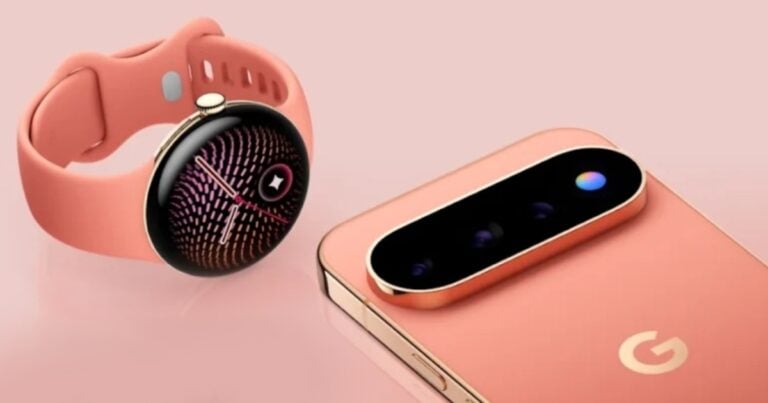

Testing the new Google Pixel 11 Pro XL and Google Pixel Watch 5 to see if this year’s devices are innovations or iterations.
Building upon a successful flagship is often tricky territory for smartphone companies. Tinker too much and you risk alienating your userbase. Not enough and you look stale by comparison. It’s why after a few weeks of testing, both the Google Pixel 11 Pro XL and Google Pixel Watch 5 feel equal parts cautious and reliable.
Straight out of the box, the Pixel 11 Pro XL looks strikingly similar to that of the Pixel 10 Pro XL. Like many of the major manufacturers, Google has chosen not to stray too far from its tried and tested formula. That inevitably leads to the unit’s look and feel feeling relatively familiar. That’s because their dimensions are almost identical, outside of a slightly lower weight in the hand at 226g instead of 232g. Behind the scenes is the new Tensor G6 chip, but flick to the back of the phone and you will notice arguably its biggest change.
Hiding inside Pixel 11 Pro XL’s signature camera bar (which is now sporting an all-glass finish) is HiLight. Despite the persistent rumours of the feature taking the form of a full light bar, HiLight is instead a single LED indicator (incorporated into your regular flashlight) that can light up when your phone is turned face down.
It’s an interesting inclusion but for the moment seems a little underbaked. The colour variety is relatively limited as is HiLight’s functionality – currently restricted to speaking with Gemini and calls from contacts in your favourites list. When a company like Nothing is setting a lot of focus on its highly-customisable glyph bar and glyph matrix, it’s natural to crave a a richer experience from the Pixel 11 Pro XL.
The phone’s triple camera setup meanwhile, continues to shoot some of the best photos you’ll find on an Android, backed up by Google’s consistently impressive post-processing software. Colours pop and low-light conditions don’t prove too much trouble either. Video does continue to struggle compared to the likes of Apple, but it is slowly making some strides forward.
Love Film & TV?
Get your daily dose of everything happening in music, film and TV in Australia and abroad.

Interestingly though, one of the Pixel 11 Pro XL’s selling points is with its display, featuring a new Corning Gorilla Glass Victus 2 cover glass that is said to be more than 2 times scratch resistant, yet during our time with the device the phone is already showing some permanent scratches in a couple of areas. Long story short: you’ll still want to throw a screen protector on to keep things safe and secure.
Starting at $2,099 the Google Pixel 11 Pro XL certainly not a cheap investment. That’s especially salient given that the starting 256GB device will only nab you 12GB of RAM (compared to the 16GB default found in the 10 Pro XL). You’ll need to jump to the 512GB for a RAM bump, but that will similarly bump the price tag to a pretty hefty $2,229. It’s worth noting Google is not alone in this, and the RAM shortage is affecting the price of technology across the board, but it’s still an unfortunate reality to live in. That said, most users of the device are unlikely to ever come close to pushing the limits on either model, so unless you’re a power user it’s not something you need to get too worried about.
Plus, hardware has never been the Pixel’s game. Instead, it’s all in the software, and that’s no different here. Magic Capture, for example, uses both on-device intelligence and Gemini to automatically capture both phones and videos while you focus on the action, and the new Creator Suite allows gives a leg up for those dabbling with content creation thanks to helpful additions like an auto scrolling teleprompter. How much you get out of these will wildly vary, but it’s helping build a full roster of features designed to lure you into Google’s ecosystem.
That’s in addition to the standard Pixel operating system, which has always felt strikingly similar to iOS. Much of your interaction with the Pixel 11 Pro XL will feel pretty familiar, albeit with the added benefit of customisation and tinkering that the Android platform allows.
This Pixel 11 Pro XL’s familiarity also naturally carries across to the Pixel Watch 5 as well, which has seen welcome but incremental upgrades from last year’s model. Once again you’ll have the choice between 41 mm and 45 mm variants, both sporting the rounded AMOLED display introduced in last year’s release. If you missed it last year, the domed glass gives everything a bit more pop and is far easier to read notifications. It’s also very nice to look at.
The Pixel Watch 5’s main upgrade continues to push integration with Google Gemini. This year that means personalised coaching that can read and process your health data better than before, as well as proactive notifications that will surface context-specific content across your apps. It never feels truly revolutionary, but the small helpful moments will still make your life easier in the long term.
One of the more fun uses of AI though is the new Create Watch Face app. The app itself allows you to choose from a list of predetermined categories/themes or describe the watch face of your dreams. They all follow the same general layout, but the app does allow for some pretty flexible colour designs – like a Matrix-inspired layout that exudes a green-hued interface. It’s not always perfect but it does allow for a level of personalisation you won’t find in many other devices and is a real joy to mess around with.
Battery life remains incredibly reliable with at least two days of easy use with always-on display. Juicing it back up is also rather speedy – back to full capacity within an hour.
Both the Google Pixel 11 Pro XL and Pixel Watch 5 are impressive and reliable devices. The fact of the matter remains though, if you already own either of last year’s models, there’s not a whole lot to lure you towards an upgrade, especially given the rising costs of investment. But if you’ve been delaying an upgrade for some time, or this is the first time you’re jumping into the Android ecosystem, it’s hard to image you’ll be disappointed.