



































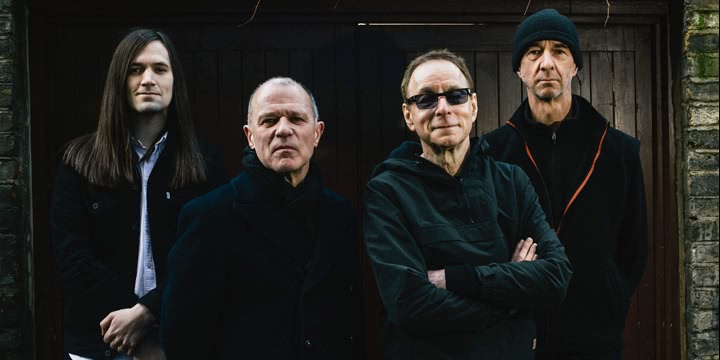

Wire, the seminal art rock band of the late ’70s who brooded in monochrome press photos and drawled over dirty, distorted guitar riffs onstage, have spent nearly 40 years evolving and reinventing themselves to meet the maturing attitudes of their members. Now, with the release of a 14th studio album, Wire, frontman Colin Newman contrasts the band’s musical origins with the eponymous new work.
“Wire has always been, in some ways, the genesis or the reaction to punk, rather than being from punk,” says Newman. “It’s simply not wanting to be part of it. It’s not a genre or form of musical expression that excites me very much. It’s mainly dead. It was dead in about five minutes; that was the problem with it. There’s a lot of people that seem to be liking its corpse, but it never excited me very much.”
Hailed as forebears to both post-punk and art rock, Wire’s constantly evolving sound has inspired countless alternative bands over the years, but for Newman, genre is an empty word.
“I don’t know what either of those [genres] really mean, to be quite honest. I think people who make their music to fit a genre have already made a decision about what they’re going to do before they’ve done it. Why don’t they do it and worry about what it is afterwards? Or not worry about it at all, just do the thing that you do.”
So when it comes to describing the self-titled new album, with its dreamy, raincoat melodies and dark riffs – a far call from the band’s 1977 debut, Pink Flag – Newman focuses on the textures and inspiration, rather than the niche it fits.
“Its roots are in some kind of psychedelic pop in the ’60s; its idealism has always been in that progressive, slightly unhinged edge. But it meets kind of a darker energy as well, which is something a bit more primal. Wire is kind of a mixture of those two things.”
When asked how the band has managed to orient itself while evolving its sound over so many years, Newman says it’s a mix between challenging each other and finding good habits. One of these habits, of course, is the two-year turnaround for albums that Wire hold themselves to.
“We just have different strategies for doing things – we just find a different way of doing them or just refine the methods that we have. There’s different ways of doing it and one of those is pressure, actually,” says Newman. “If you tour during the album year, it means you don’t have a lot of space to do much else. So that provides a kind of pressure and it works you a bit harder. I think that spending five or six years between albums, you’d lose the will to live. If you’re in the flow of it, you might as well just keep in the flow and allow it to go where it goes.”
Inevitably, being an art-driven band means delving into each member’s creativity to find new inspiration. However, Wire must walk a fine line between exploration and familiarity. Newman admits that focusing on new material occasionally risks alienating fans, but it’s inevitable nonetheless.
“The whole concept of ‘Wire’s Greatest Hits’ is absurd, because we never had any hits. All the ‘hits’ are emotional. If you talked to 50 Wire fans and asked them to give 20 songs of their favourite ones, they’d all come with a different answer. You’d never get any agreement on what the hits were in the first place. Some people are outraged because they think a particular song, because it’s their personal favourite, that that’s what everyone else thinks, but it doesn’t quite work like that. The most important thing is, when you play a gig, that you play with some kind of conviction and you play stuff you want to play. Otherwise, that’s just entertainment and that’s not what we do.”
The latest album marks the first time guitarist Matthew Simms has contributed significantly to recording. Understandably, it begs the question of whether Simms has altered Wire’s creative process. However, Newman sees Simms’ role as more of an augmentation than a mutation.
“We divide writing up into two types of thing: there’s the song and the melody, and the way the actual song is constructed; and the text, which is how songs are usually constructed. In Wire we have another element to that, which is the music, which is what the band does. That music is made by four individuals and Matt is very much a contributing person to that. It’s about taking a piece which is, as it were, formed by the lengths but which is still very much a skeleton, and then the band brings that to life. In that way, I think he helps us go in a direction we were going in already.”
Finally, with Wire celebrating their 40th anniversary next year and Newman in his sexagenarian years, he contemplates on the future of the group and whether he can ever foresee a time when Wire might call it a day.
“I don’t think so. I think if it stopped being any good or stopped being able to be done, for whatever reason, then I would just walk away from it. But at the moment everybody seems motivated towards making this work and I think we have a unique little moment to do something.”