



































Dream On Dreamer’s newest release takes the band in an independent direction – an alien journey considering they’ve made their name by working with a label for most of their career.
The Melbourne post-hardcore outfit’s new approach has allowed vocalist Marcel Gadacz to work on his craft in a more earnest way, and his outlook towards independence is bright.
“I guess in some small way we still have that old-school mentality like bands like Fugazi,” says Gadacz. “When I was 16 or 17 or something I was into that straight-edge hardcore. Obviously that’s changed, but compared to [what was then] going on in the scene, right now there’s nothing but pop art and pop music. It’s literally almost to a point where it makes you angry about what hardcore – or so they call it these days – has turned into. It’s an absolute joke. We’re competing with charting next to Justin Bieber.”
Earlier waves of hardcore or metalcore bands wouldn’t ever have been heard on triple j or any large-scale commercial music platform, but the genre has undergone some drastic changes in the past decade. As far back as 2009, bands like Parkway Drive began appearing on indie festival bills. Electronic influences and cleaner vocals started co-existing in the music of groups such as Bring Me The Horizon, Enter Shikari and others, making the chaos of older metalcore styles more digestible for a discerning public. While Gadacz admits there have been changes, both good and bad, the newfound popularity of the heavy scene has worked in Dream On Dreamer’s favour.
“I’m not saying we’re not like that – we can’t help the fact that this music is getting more popular in the ARIA charts,” says Gadacz. “There’s nothing wrong with it, it just shows that there’s more chances and possibilities for these kind of acts to come out. In terms of the whole DIY thing, what’s the point? We’re trying not to be a band that just creates music, we create our own art – for example, when it comes to anything that we print, whether it’s T-shirts, CD artworks, everything, we’ve been able to create it ourselves.
“It’s really something where if you’re connected to Dream On Dreamer, you’re not just connected to the music, you’re connected to the lyrical side of things, to our art in general. For us, it’s a really good way to connect with the fans, especially on a personal level, as I’m behind the whole artwork. It’s something I can really embrace – I’m fully myself. I can put as much energy as I want into the art side of things, and people are connecting to it, and it’s one of the best rewards a band can have. It’s really amazing to see.”
Nevertheless, Gadacz believes there are too many heavy artists getting caught in the rock star mentality and forgetting what living as a band should be about. He sees it as a generational issue, as if the old wave of metalcore that people like him grew up with isn’t reaching the youth as it did previously.
“We don’t really feel inspired by the industry at the moment,” says Gadacz. “We don’t feel inspired by what’s going on. When you are involved with this stuff, you realise how fake everything is. Society is already fake as is; if we want to be in a scene where people are divided, where there’s a true passion or true movement or unity, mental states and the like, I think you can’t be doing what the bands are doing at the moment – doing the whole pop thing and betraying people or falling into their hands about things. The industry is so full of lies. It gets you to a point where I’d rather play to 50 people who actually give a shit over 5,000 people who just came because they were told to be there, told to like this because it’s what the industry does.
“That’s just frustrating to see,” he adds. “It’s not why we got into this music in the first place. Bands like Fugazi, all that kind of stuff – we have our roots in that mentality, and the reason why those bands existed is that they didn’t want to get caught up in that fake stuff that’s going out. It’s just one of those things. I don’t know how many people give a shit these days and pick up that kind of stuff. Obviously we have younger fans as well that have no idea about these bands. They don’t know about bands that might come from a Deathwish label – they don’t know who Converge is. They don’t know that kind of stuff, and you can’t really blame them.
“But you can set that example in the modern industry to be inspired by bands like ours, rather than – not to name anyone – but other acts.”
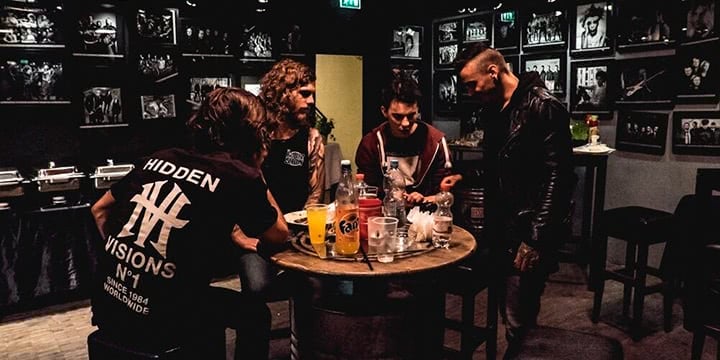
[Dream On Dreamer photo by Mark Klienert]
Dream On Dreamer‘sSongs Of Soulitude is out now independently, and Friday November 20 they play the Factory Theatre withPolaris.