



































If you’ll allow me a name-droppy wanky journalist story, a few years ago I was at the Rainbow Bar & Grill in LA with Aussie metal promoter/legend John Howarth, Fear Factory’s manager and a dude from Live Nation.
The Live Nation guy was telling us about this new band, Ghost, whom he’d just booked to play the House Of Blues on the Sunset Strip.
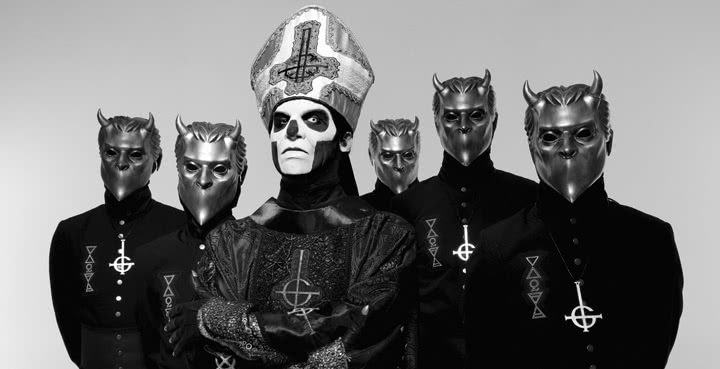
“They’re fucking great,” he told us. “They dress like evil priests, their singer is an evil Pope, and they sing about how much they love Satan. It’s great to have some good old-fashioned Satan worship back in metal.”
Within about six months Ghost had completely blown up, and now they’re about to release album number three, Meliora – which, like its two predecessors, pays tribute to the occult rock and metal of the ’70s while maintaining an unmistakably ghostly sound. This album introduces Papa Emeritus III (really the same vocalist as on the previous two albums, but the story goes that this Papa is “the three-months-younger brother of Papa II”). The instrumentalists are referred to simply as Nameless Ghouls.
“Just for reference, I’m the main songwriter and instigator of the band,” a Nameless Ghoul says over the phone. “So you don’t have to worry about talking to some fucking henchman.”
Meliora has a heavier, more aggressive feel than its predecessor, with a few thrash-influenced rhythm guitar moments and an overall edgier sonic approach. “It was a plan to make the record this way,” says the Ghoul. “With the experience we had with the last album, there were a few decisions made in the production stage which made the album sound a little un-muscular, if you will. That was never the intention. We’ve always strived for a sort of an analogue, warm sound, but it was never our intention to make it sound too lo-fi. We always wanted a hi-fi thing.
“So we thought going into this next record we might want to add a little more muscular DNA. Because we come from a riffing background, it wasn’t like we thought, ‘Oh shit, we have to go to rock’n’roll school to learn to play riffs,’ but we tended to over-emphasise that when we were writing the songs. Even though most of our songs are usually vocal-based, I think that on the previous record it might have been one step too much towards that, so we wanted it to be a little more riff-driven.”
As analogue purists, Ghost use only old gear – “just because it adds not only to the sound but the feeling,” says the Ghoul. “It feels right doing that. This time we basically had museum pieces. We were using a mixture of four guitars right through the record. It was the same guitars and the same set-up. That’s something we’ve always strived for: the songs should all be different but it should be the same sound across the board.
“So it was two Gibson SGs – one was ’62, one was maybe a ’79 or something. Then we had an old Les Paul Goldtop and apart from the Neve console it was the most valuable thing in the studio. That was fantastic. It was all cracked up like the Mona Lisa. It had gone green, like gold-green. And then we added a Telecaster in there. We are a Gibson band, but a Fender added into a Gibson world can be very effective. And we used a larger range of different speakers and heads to create a lot of depth in the guitar sound.”
Onstage, the Ghouls use Gibson RD models from the 1970s, which are modified a little to make them more roadworthy. “They’re slightly customised because the old ones from ’77 are extremely cool guitars, very cool-looking, but in order to make them sound like a normal guitar as we know it, you need to rip the insides out and put in new ones,” says the Ghoul. “I’m sorry to say, but they weren’t really great guitars. They look cool, but you have to go through a little procedure. But speaking of analogue gear, onstage, because we don’t have amps onstage – in the beginning we had a big heavy analogue backline, but as most bands nowadays, if you don’t have it onstage and you’re not depending on that muscle that you can lean your ass on, there’s really no need to have a big heavy backline – so we have simulated that through a rack of Fractal Audio Axe-Fx on the side of the stage.
“At the end of the day, you have to realise that as much as I love playing and as much as I want a big rig that is super loud and a lot of functional pedals and lots of cables, this is our job and we are working, and you have to have someone else take care of your shit, and it has to be quick and it has to work the same way night after night for 200 nights per album,” says the Ghoul. “It’s very impractical to go out with a wall of Marshalls because it will kill you and kill your roadie. We did that for two years and it was horrible. Everything gets fucked up. Even though we had an Orange endorsement, you have to rely on what the local person has in terms of Oranges, so all of a sudden they bring in two Oranges and one of them doesn’t work and one is on its last tube so you end up playing Marshall anyway.
“So it’s like, ‘Why are we breaking our crew’s back trying to fix this thing? We can do the Fractal thing, have it over and done with – everyone’s happy and we can pretend that we have a big wall of amplifiers behind us anyway. It’s all make-believe anyway, this rock’n’roll thing.”