



































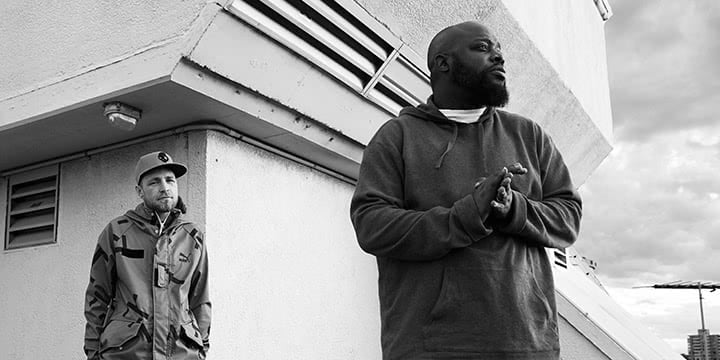

Back in 2011, during an Australian tour with fellow Detroit native Phat Kat, Guilty Simpson had just finished a show when he got a call from local producer Katalyst.
Hours later, Simpson was in the studio dropping a verse for the track ‘War Drums’. It was a casual meet-up that has evolved into a five-year-long working relationship.
“Me and Phat Kat were kind of bored,” Simpson recalls. “Katalyst wanted to know if we wanted to come, smoke and listen to some beats, so we ended up going, and he had these super sick beats! Later on we were labelmates and that’s how the album came about. We’d always planned on working together, so a harmless smoke session turned into Detroit’s Son.”
The partnership is just one of a long line of collaborations in Simpson’s career. The MC’s mainstream breakthrough was on a J Dilla collaboration called ‘Stress’, which in turn introduced Simpson to his current label, Stones Throw Records. Since then he has worked with hip hop luminaries Madlib, Black Milk and Sean Price on various projects, crediting his success to a down-to-earth approach to music.
“I’m not gonna try to put a square peg in a circle, that’s just me,” Simpson says. “My collaboration with them is to be honest with my interpretation of what the music should be. I’m gonna trust the producer to produce, I’m gonna trust his vision – if I can’t trust his vision to do his job, then we shouldn’t collaborate. And I think that’s the same faith he should have with me with the rhymes. I’m definitely not opposed to taking input, but at the same time, I still would like to have the freedom to express myself. I think that’s what we all deserve as artists.”
That mutual respect is evident in the production of Detroit’s Son, which landed in stores last year. Despite Katalyst having never visited Detroit, Simpson was adamant the Australian producer was the ideal person to work with. “I didn’t want him to be anything that he isn’t. I wanted to mesh my visuals with his musical landscape, so to speak. I wanted to more or less coexist … His range of production made it easy to do that, and not necessarily repeat the same song every time.”
The end product is a bracing album full of rousing beats, tied together by Simpson’s gritty raps about the Motor City streets. It is Simpson’s fierce loyalty to his hometown and history that distinguishes him in his music, as well as in person. His rhymes proudly represent the Detroit locals he brushes shoulders with, but he also holds a firm belief in the ability of the city to thrive despite its negative reputation. His faith in the work ethic of Detroit sits at the core of his identity, and it was what helped Simpson establish himself at the outset of his rap career. His first task was to draw a line between himself as a solo artist and as a member of his first crew, the ten-member Almighty Dreadnaughtz.
“After I got exceptional at [rapping], I felt it was a way for me to provide for my family, for me to see the world. I took it very serious,” says Simpson. “I took myself away from the rap scene and started focusing on stuff that really counted. I did have to make a divide with the fellas, but at the same time they’re still family. Anybody that calls themselves an Almighty Dreadnaught is still a very good friend of mine.”
Originally introduced to the collective through a friend in high school, Simpson quickly discovered he was a natural. “It was like a fish to water for me. I think in my subconscious I was like, ‘Wow, this is what you’re going to do one day.’ Those were my early days, but yeah, I connected with those guys. After the first day in the studio, I never stopped going, it’s as simple as that.”
Perhaps in recognition of the role Almighty Dreadnaughtz played in helping him realise his abilities, Simpson now mentors kids from his area who don’t have strong male role models. And with over a decade of experience in the Detroit underground scene, there is no sign of Simpson’s work coming to a halt. The irony is that even for a prolific artist like Simpson, the digital economy has changed the nature of the game.
“I think a lot of fans now are kinda casual. There’s a lot of music, bro. It’s very difficult to preserve some of these projects. I’ll drop a project and a guy’ll be like, ‘I’ve been listening to the album for two weeks, where’s the next one?’ Especially with me, back in my super fan days before I was actually rhyming, I would never think that I could get enough of an album. It’s just a different time.”
On that front, Simpson and Katalyst see eye to eye. In the BRAG’s recent Five Things interview with Katalyst, the Aussie producer spoke about music losing its value. Simpson is asked how he feels piracy affects underground artists.
“That’s why I’m thankful for shows, because that’s something that they can’t duplicate,” he says. “I’m definitely someone that understands the change in time, I understand people using [technology]. It’s just people that abuse it that I take exception to. You should use it to support – I’m a firm believer in that.”
Guilty Simpson & Katalyst’sDetroit’s Son is out now through Stones Throw. Expect to see them at Plan B Small ClubFriday February 5, with Sampa The Great.