



































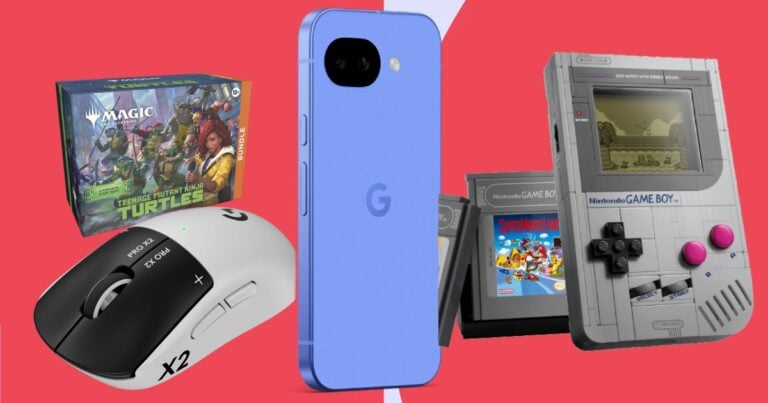

From the Google Pixel 10a, to the LEGO Game Boy and Logitech G PRO X2 gaming mouse – this is some of the best new gear around.
When the Google Pixel 9a launched in 2025, it was Google’s best all-rounder offering. It walked the tightrope between features and feasibility with a pretty appealing price in tow. Thankfully many of those sentiments continue to ring true with the Google Pixel 10a, but there’s a catch. That’s because, truth be told, it’s largely the same phone as last year.
Put the phones in a blind line-up and you’ll find that most regular punters won’t be able to tell one from another. The screen remains a 6.3-inch 1080 x 2424 OLED display, there’s still a dual rear camera system including a 48 MP wide and 13 MP ultrawide, and the Google Tensor G4 chip is still powering the main internals. Even the colours are remarkably similar, albeit the 10a’s variants do pop slightly more this time around to give things a smidge more style and vibrancy.
So, what is different? Well your main display has now been upgraded to Corning Gorilla Glass 7i – a much studier option than last year’s model that should do a much better job at preventing nicks and scratches from general wear and tear. You can also enjoy a higher peak brightness (3,000 nits up from 2,700).
What you’re most likely to notice though are slightly faster charging speeds which will see you charge up to 50% in about 30 minutes with a 45W charger, an additional 20 hours of battery life when utilising extreme battery mode and a completely flat camera bar at the rear. Yes, while the 9a did well to create only the slightest of bumps, this iteration has to be commended for presenting zero wobble when placed on a table – a real achievement in today’s mobile landscape.
But while these changes are obviously minimal, perhaps the Pixel 10a’s most disappointing omission is the 10 series’ biggest boon: Pixelsnap. While it’s obviously understandable that Google wants to keep the price down on its budget offering, it does prevent the phone from having an easily marketable difference.
Love Film & TV?
Get your daily dose of everything happening in music, film and TV in Australia and abroad.

And that ultimately leads to the discussion around the Pixel 10a as a whole. During testing performance was largely in line with the 9a. Day-to-day activities are snappy and responsive thanks to the 60-120 Hz screen and Google’s core AI offerings like the new Camera Coach are still capably handled by the Tensor Chip. That said, you are still going to see some limitations when it comes to more intensive activities like gaming with the graphically intensive games slowing to an absolute halt.
In a world where most people upgrade their phone every few years it makes sense that Google wants to update its budget offering, even if it’s quite minimal. There’s no reason to upgrade from the 9a, but if you’re new to the market, considering the price tag remains unchanged from last year – with an $849 asking price on the Google Store – the Google Pixel 10a remains a pretty appealing proposition that’s hard to be too upset with.
Also out now…
Logitech G PRO X2 SUPERSTRIKE Wireless Gaming Mouse
Gaming mice feel like a dime-a-dozen these days, but not so for the Logitech G PRO X2 SUPERSTRIKE. Straight out of the box Logitech’s latest is an appealing device. At 61 grams it’s relatively light, but may feel a little on the large side for those with smaller hands. The black/white design choice meanwhile isn’t incredibly common but works exceptionally well here and adds a bit of flair to what would appear to be a relatively traditional mouse.
But the PRO X2 SUPERSTRIKE is far from traditional. No, this potentially game-changing unit is actually trying something pretty darn interesting and has booted the typical clicky switches found in most mice. In its place: a haptic trigger system.
This Haptic Inductive Trigger System (also known as HITS) is triggered the moment you push down on a mouse key. But instead of the traditional sound you’d expect to hear, you’ll instead feel it pulse beneath fingers almost immediately. Without power the mouse feels strangely spongey and to be honest the whole experience takes a bit of getting used to. Once you do, Logitech claims that the new system cuts click latency by up to 30 milliseconds, and while that makes it perfect for truly competitive gamers, it did help make a small improvement in my own competitive rounds of Call of Duty and Marvel Rivals.
A large part of that is thanks to the adjustability Logitech allows. Both the travel distance required for each click as well as its intensity can be tinkered with within the PRO X2 SUPERSTRIKE’s software offering. There’s ten actuation points and six intensity levels to choose from which can honestly be a little overwhelming to a casual audience. I loved playing around with the settings but it can occasionally be difficult to tell large discernible differences in the middle of the spectrum. That said, go to the more intense end and you will be able to replicate a more typical mouse feel if that’s your speed.
Setting you back $299, the Logitech G PRO X2 SUPERSTRIKE is far from a cheap mouse, and as such recommending it feels slightly conditional. If you’re looking to kit out your gaming setup and want to try something a little experimental, this could be the perfect purchase. Casual gamers on the other hand may not value the promised benefits here, but don’t be shocked if you change your mind the moment you give it a bit of a test drive.
Magic: The Gathering – Teenage Mutant Ninja Turtles
Magic: The Gathering is no stranger to collaborations. From Assassin’s Creed to Final Fantasy, the increasingly popular card game is not afraid to stretch our legs. But while the upcoming Marvel Superheroes release is a no brainer, Teenage Mutant Ninja Turtles probably wasn’t on anybody’s bingo card. Yet somehow, this latest release goes down as well as a piping hot pizza.
What you’re bound to immediately notice is due to the Turtle’s inherent source material it has allowed Magic’s art team to go absolutely wild. Some cards looked ripped right out of the Turtles’ comic book origin, while others feel right at home with the insanely popular 80s cartoons. Some pay homage to the series’ video game outings with some pixelated efforts and a few could have pulled right out of a traditional Magic booster pack. It leaves each unopened booster with a sense of excitement because you truly never know what you’re going to reveal next. Hell, even the Bundle storage box is a work of art that doesn’t deserve to be spoiled.
In terms of mechanics, the team has done well to lean into classic Turtle lore. Case in point: Mutagen allows you to generate Mutagen tokens, which act as artefacts that can be sacrificed for +1/+1 counters on target creatures, while alliances sets its sight on teamwork, buffing one creature when another enters the battlefield.
But this connective tissue doesn’t stop there because Magic: The Gathering: Teenage Mutant Ninja Turtles also introduces a whole new element to the mix dubbed Turtle Team Up, and while I was unable to test the mode during my time, it’s an incredibly smart idea.
Where traditional Magic is designed around competitive play, Turtle Team up is all about cooperation, allowing up to four players to team up with four 60-card decks (centred around each of the turtles) to take on Shredder and his nefarious clan. The kit includes everything you need like custom counters, an enemy deck and rule book with each round designed to last about 45 minutes. It’s an incredibly smart tie-in to the source material and something I’d love to see Magic play around with more in the future.
Simply put, Magic: The Gathering – Teenage Mutant Ninja Turtles is the card game seemingly having the most fun in quite some time and is an easy recommendation.
LEGO Game Boy
If you’re a Nintendo fan and a gamer it’s a truly wonderful time to be alive. From Pokémon to Zelda and even Animal Crossing and Mario there’s truly no shortage of sets the brick maestros have been releasing over the last few years. But if you’re looking for a real nostalgic hit then there may be no better option than the LEGO Game Boy.
At 421 pieces, you shouldn’t expect the most complex build, especially when compared to likes of past models like the Nintendo Entertainment System at 2646. That doesn’t mean the build isn’t without its charm though, and there’s an inherent satisfaction of rebuilding the handheld’s core components like its signature pink buttons or functional Game Pak slot. The instruction manual also does well to detail some of the history of the Game Boy which is a nice touch.
Speaking of design though, the LEGO Game Boy hits the spot. Where LEGO has copped a bit of criticism lately for implementing an increasing number of bespoke pieces inside newer sets like the recently released Pikachu or Mario Kart offerings, the default formfactor of the Gameboy lends itself incredibly well to LEGOs sensibility.
With a near 1:1 scale almost every element feels as it does on the real thing even going so far as to allow the modding community to place proper screens within the LEGO shell following the unit’s original release.
LEGO has even included two replica carts (one for The Legend of Zelda and the other for Super Mario Land) as well as the choice of two lenticular screens (a game screen or a Nintendo start screen).
At $99 (although you can often find it discounted) the LEGO Game Boy is an incredibly reasonable deal that does exceptionally well to satisfy both old-school gamers and LEGO fans without breaking the bank.