


































Experience has taught me that international phone interviews are always a roll of the dice. This is mostly because the technology seems to have been developed by gremlins, but throw multiple connections into the mix and you’re asking for trouble.
It’s exactly what happens when chatting to Mica Levi and Raisa Khan of Micachu and The Shapes. Somewhere between our three phones is an ominous sound like somebody devouring a typewriter, which in retrospect is somewhat fitting for the experimental pop trio, known for their odd time signatures and found-object appeal.
The British group’s latest release, Good Sad Happy Bad, is only days away, but already three tracks have dropped, showcasing not only how the band has progressed since 2012’s Never but also the sheer scope of the record. First single ‘Oh Baby’ is a lush, eerie pop number, while its follow-up ‘Sad’ shines as a quirky, circuitous dream. Disparate as the record is, it was born of a common fount; an evening’s rehearsal that was recorded almost as an afterthought.
“We basically decided to commit to this process of working the album from a couple of recordings we had,” says Levi. She has quite a deep and charismatic voice that wouldn’t be out of place at a poetry slam. “That was going to be the beginning of songs, kind of build them, but they ended up just being warts and all. From there I just got into the writing as normal, but I was really excited about doing it like this with the recording already there and was writing [constantly]. It wasn’t like I wrote the song and then the lyrics developed over time. My job was just to sing the lyrics – I almost didn’t have to think about the song, really.”
The fact these fledgling recordings exist at all is due to drummer Marc Pell. With his bandmates unaware he was recording the rehearsal, it allowed a level of creation and inhibition that became the bedrock of the entire album. Of particular intrigue, however, are the skeletal songs that never made it onto the final product. Given the relatively brisk length of each track (‘Sad’, for example, clocks in at just over two minutes) compared to the many hours of recordings, the trio were rather spoilt for choice. It makes you wonder if there isn’t a second release still haunting the studio.
“Yeah, totally!” Levi says. “There’s some really great bits in there. Prior to other situations we’ve been in, we’ve had lots of bits of ideas that have been more about getting something together, but we basically had to decide on a vibe – where the record was going to go based on things that we thought had the right and accurate energy. We decided that there were a few particular strengths there that we went towards, but there are other good sets in there.”
“We certainly wanted to do more at the time,” Khan recalls.
“We kind of wanted to do two records,” Levi laughs. “A daytime record and a night-time record.”
Tremendous as this idea sounds, Good Sad Happy Bad already has great variety without losing any coherence. There is something oddly disquieting about its blend of simple, soothing sounds and unexpected movements, like waking abruptly from a dream. Establishing an overarching, whole-album experience was at the core of deciding which songs would be pursued and included, yet as Khan explains, the trick was not to overthink the process.
“I think with this record, the reason it was quick and had to stay quick was the more you do to it, the more fraudulent it’s going to become,” she says. “We have to all stand back and make a judgement on it, to see if it feels like it should. To be honest, we made the decisions based on the flavours of songs more than anything. More than whether if it [felt] finished, it was more … what kind of feeling it could have. If we kept working, it might take it to the wrong mood.
“A song like ‘Oh Baby’ stands on its own two feet quite well, but a lot of the other songs need to be seen as part of the record. Sometimes the ones you originally would like to sit in that means not going with your favourite at all. It has to be about the whole thing.”
“I find [a song is] great at first,” adds Levi, “but if there’s just one thing wrong with it, like there’s a little smudge, you start looking at that, try to fix it, and you just fuck everything up, and spend the rest of your time trying to get it back to where it was originally. The beginning is always the best bit. The hard part is taking it through to the end – that’s the work. I think there’s something that feels really pure in doing that. I don’t know, I always … it’s like you’ve got to practice in your own time to get a performance together, you know? By the time that you press ‘record’ you should have your shit together enough that you trust what you’re going to do. In my mind that’s ideal, in terms of a performer.
“You can’t polish a turd,” she finishes matter-of-factly, and Khan chuckles. “You’ve got to know if it’s punching above its weight. If you’re fucking around with it too much, it just becomes a different thing.”
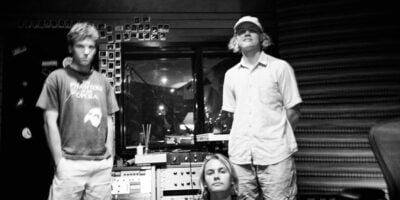
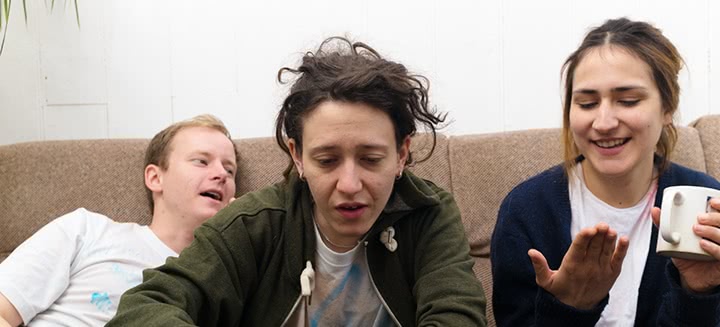
[Micachu and The Shapes photo by Steven Legere]
Good Sad Happy Bad is out Friday September 11 through Rough Trade/Remote Control.