



































Midway through my discussion with Ambrose Kenny-Smith – lead singer, harmonica player and songwriter with The Murlocs – the conversation veers into a discussion of the deviant behaviour of serial killers.
Kenny-Smith’s interest in serial killer documentaries inspired the lyrics to ‘Wolf Creep’ on The Murlocs’ new album Young Blindness; my own Adelaide background leads me to offer a brief history of Adelaide’s notorious ‘Family’ serial killings in the early 1980s.
“We’ve had this weird curse with Adelaide,” says Kenny-Smith when I ask him if The Murlocs have ventured to the South Australian capital. “The first time was alright, the second time our friend who we’d brought along to drive had lost his X1000 video camera along with the keys to the rental car, so the next day we had to fork out for a new car, and long story short, we lost all the tour money. And the next time we played, which was on our last tour, the bass player had an allergic reaction and we had to play as a four-piece. So Adelaide’s been interesting!”
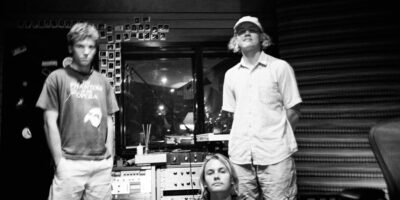
Such challenging touring moments aside, The Murlocs’ experience over the last couple of years has been a mixture of progress and delay. In early 2015, the band entered the studio with Stu Mackenzie (the enigmatic psychedelic auteur behind King Gizzard and The Lizard Wizard) to record a second album. But despite those sessions taking just a week, it took over a year for the record to finally be released. With the runaway success of King Gizzard – with whom Kenny-Smith and Murlocs guitarist Cook Craig also play – the logistics of finishing the album proved particularly difficult.
That said, Kenny-Smith says The Murlocs are gradually becoming more pragmatic in their attitude to recording and mixing. The songs on Young Blindness were written originally by either Kenny-Smith or guitarist Cal Shortal, though typically on the basis of rough song sketches that were finished by the band together.
“I think The Murlocs have become pretty formulated without meaning to,” Kenny-Smith says. “Most of the time, Cal or I will come up with ideas and then flesh it out with the rest of the dudes. With this record, a few of the songs were more so mine, coming up with them on guitar and bringing it to the rest of the guys. But most of the time it kind of comes out in a similar kind of vibe to what we’ve always done. There’s not really a huge concept in the music, more so in the lyrics.”
While Shortal’s contributions have tended to derive from the guitarist looping riffs, Kenny-Smith has focused on writing specific guitar melodies, which he then complements with lyrical ideas conceived during his travels. “Now and again, especially when we go away with Gizzard, I used to try and write something every day, whatever stream-of-consciousness sort of thing,” Kenny-Smith says. “But more and more so, I just try to get a melody going on the guitar and then figure out the words later – it can be either/either.”
Kenny-Smith says he was keen for Young Blindness to capture the distinctive tremolo production aesthetic of ’60s garage records, but it was also important for the record to reflect the band’s soul influences.
“This record was recorded with Stu Mackenzie, who’s not only a close friend of ours but he also knows what we want. The first EP was a bit hit-and-miss, but we got more of what we should’ve sounded like in the second one. We aspired to that garage ’60s type of sound, but we also tried to get this soulful vibe going, and we also like a lot of punk music too, so it kind of gets thrown in the middle somewhere. Most of the time I like to keep it pretty in-your-face, but not too… my voice can come across too squealing, pinching, something like that. I like to find as warm a sound as we can, but also keeping it scruffy.”
Kenny-Smith concedes that his contemplation of the appropriate tracklist for the album was part of the cause of the delay in finishing the record. “I mucked around a lot with sequencing, but I’m pretty happy with it now – I can still listen to it today, which is a good sign.”
The final sequence, Kenny-Smith says, arguably reflects how The Murlocs work: “Ideas start off promising, then they go grim, and by the end of it we can see the light at the end of the tunnel. We sit on songs for a bit too long sometimes, and we don’t really question our material until after we’ve been playing it for quite a while. That’s probably where we lack the most – we’re happy with the first product, and then much further down the track, we realise it has to change for the better.”
The Murlocs’Young Blindness is out now through Flightless/Remote Control, and they hit the Oxford Art Factorystage Thursday April 14, withCrepes.