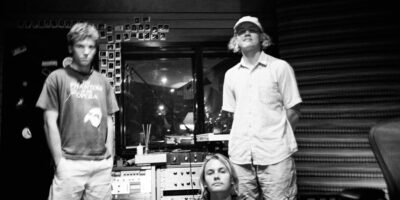





































Kody Nielson’s career path has moved through a series of stylistic mutations. After leading art-punk/power-pop outfit The Mint Chicks, he jumped over to the clean, pop eclecticism of Opossum, and then released a jazz-inspired instrumental solo EP,Devils, in 2013.
Earlier this year, he gave his brother Ruban a hand with the third album for his band, Unknown Mortal Orchestra. Now, Kody Nielson is gearing up to release Personal Computer – an LP of funked-up, lo-fi electronic pop music – under the moniker Silicon.
Although his stylistic focus has undergone some distinct shifts over the last decade or so, one constant has been Nielson’s keen melodic capacity, which has given everything a sense of cohesion.
“I just like songs,” he says. “Whatever the production or style or whatever, it still actually needs a song. I’ve always tried to keep melodic songs throughout different projects. I suppose I just enjoy that kind of music to listen to.”
Meanwhile, Personal Computer certainly isn’t lacking in experimental flourishes. For instance, the album begins with a monologue recited by an android voice; the chirpy 60-second sequence ‘Little Dancing Baby’ combines childlike female vocals with a club-ready bass groove; and ‘Love Peace’ fluctuates between plaintive piano balladry and stabs of whacked-out disco funk. However, as with past projects, Nielson’s attention to songcraft keeps his experimental tendencies from becoming overwhelming.
“Everything I work on, I try to keep a similar approach,” he says. “I just take extra things here and there, whatever is inspiring at the time, and just try to run with that. Whatever’s inspiring or excited me to keep making music, I’ll just try to run with that.”
With this in mind, one wonders what catalysed the Silicon project. After a handful of years leading Opossum (which also featured New Zealand pop singer Bic Runga and former Mint Chicks bassist Michael Logie), a combination of necessity and frustration led Nielson to break away.
“Having broken up with Opossum – or everyone in Opossum got a bit too busy – I just continued trying to write music and make music on my own again,” he says. “I wanted the music to be the finished music. I didn’t want to write more demos. I was kind of doing it all as I went along. With this, there was a bit more freedom to just do it and finish it. I didn’t really have to consider anyone else’s ideas or feelings or anything. I just wanted to do something very simple.”
But while Nielson had a few aims for what this new outlet of expression would encompass, he didn’t bank on it evolving into a fully-fledged project. “To be honest, I was just getting a bit sick of band music. I was getting a little bit sick of not just bands, but also just the band politics and dynamics. When it came to working or touring or playing, it was just not fun, I guess.
“[Silicon] was just sort of getting on with my own thing and doing it for fun, rather than having expectations of what people would think or having to plan it for a group. I guess it just ended up being a whole new project. I was just banging away at it in my spare time.”
Personal Computer steers clear of the slick muscularity of 21st century studio productions. Instead, the album makes heavy use of keyboards, synth bass, drum programming and other electronic elements.
“I used to make electronic music on my own with a Roland W-30 sequencer and put it to four-track. This was before The Mint Chicks. That’s when I first started recording. “In a way, I just went back to that default mode and just tried to start making music in that way again, which was pretty carefree.”
Despite the sequencer being a close accomplice during the album-making procedure, Nielson would still conceive the basic outline of songs before putting anything to tape.
“Most of the time it was a song I’d written on keyboard or written on drums and I’d start trying to layer it all up like that. I tried to start off with the song kind of written, so it’s got more of a skeleton to it. Then there’s more messing around with recording – it can be a separate thing. Having said that, I still muck around with beatmaking, samples and stuff like that. I try to mix them together a little bit – little ideas I come up with from a production point of view or beatmaking, I just try to apply them to the songs.”
Silicon started out more or less as a hobby, and the album is the direct result of the recording experiments Nielson carried out in his spare time. However, a combination of Nielson’s stimulating track record and his recent involvement with Unknown Mortal Orchestra means there’s already a lot of attention directed at the project.
“Hopefully it does allow me to keep going and make more Silicon albums,” he says. “I’m keen to keep going. I do music full-time now, but I work with other people and have to do just whatever mixing jobs or produce other bands, stuff like that. But I’d like to keep making Silicon music, definitely.”
[Silicon photo by Ralph Brown]