



































We Are The Ghosts Of The Futureis an immersive theatre production that takes freedom of experience to the next level.
Set in a boarding house in 1935, it explores the lives of the lodgers on the day of Charles Kingsford Smith’s disappearance. The piece isn’t only centred around the pioneering Australian aviator, it will also be performed to mark the 80th anniversary of his being declared missing. But the date played no part in the inspiration for the show.
“The anniversary was an amazing coincidence,” says Hilary Bell, a member of the 7-On playwrights’ collaboration. “We started this show in a different incarnation some years ago, and when we applied to have it on at The Rocks, we didn’t know we were going to get the date of the anniversary.
“The inspiration for the show was an exhibition curated by Peter Doyle and the Justice and Police Museum called City Of Shadows. It mostly consisted of forensic photographs and mugshots in Sydney between the wars and we were just really moved by and excited by that.”
Evidently, the pictures spoke a thousand words to Bell and her peers. “It was just so fascinating to see our city through these different eyes. Usually when you see photographs from that time everyone is wearing their best clothes and presenting themselves as they wanted to be remembered, but these guys had no choice,” she says.
“From there we created a show that at the time was going to be this huge piece that we wanted to put on at the old Darlinghurst Gaol. But it was too tricky for us to do, so we reconfigured it as a much more intimate piece to be set in the separate rooms of a terrace house.”
One of the unique aspects of the writing process for We Are The Ghosts Of The Future was the collaborative method, where different parts were written by the seven different writers who make up 7-On.
“7-On is a company of theatre playwrights, and we create shows together and we try to find things that you could never really write by yourself and ideas that benefit from multiple voices,” says Bell. “We really loved the idea of these little lives being played out in different rooms of a house and the audience being able to just meander. Some of the rooms will have monologues, some will have two or three people in it.”
These different stories unfold separately but still fit together as a whole. Of course, this changes the execution as well as the audience experience from that of an ordinary play.
“We had gone through a lot of different possibilities on how to calibrate it,” says Bell. “We set a limit on how long each piece would be. We set an upper limit but no lower limit and said that each piece would be as long as it needs to be. We also wanted to give the audience complete freedom to roam around and create little things that they are bound to miss. Maybe if they get a sense of those things they’ll want to come back. Little things like a pair of glasses on a staircase or a milk bottle in the backyard that hint at a bigger story will be dotted around.”
For a piece that began with mugshots and criminal profiles, it has certainly evolved and developed.
“As we worked on it we moved further away from the crime aspect,” Bell explains. “In the last few years there’s been a lot of exposure with Underbelly so it felt like it was a little bit overdone. As we researched and wrote, we were drawn to the domestic crimes of necessity, like abortion, bigamy and single mothers having to be prostitutes to raise their kids; those sorts of things instead of more flashy razor gang kind of criminals.”
Despite some of the heavy storylines that will be presented, it won’t all be blood and tragedy.
“When we put all the pieces together and read them as one, they were pretty dark and miserable,” says Bell. “We knew we had to brighten it up, so some of us went away and rewrote our sections to be much funnier, warmer and lighter, because you have to have that variety. We moved away from the tragedy but also towards the ordinary deprivations and compromises that people had to make then.”
Ultimately, these smaller tales weave together to create a bigger picture and tell an even more compelling tale.
“One of the reasons we wanted to do it in The Rocks was to speak to what’s going on at Millers Point and the selling off of public housing,” explains Bell. “Why we chose Kingsford Smith’s vanishing as the background metaphor was to do with the vanishing of Sydney and the fact that we all have this sort of arrogance that we’re the only ones who have ever lived here and will ever live here.
“Of course, like those people from 80 years ago, all trace of us will be wiped out and the next generation will think they’re the only ones who have ever lived here. We wanted to give that larger and more philosophical perspective on life and time as well as the repetitiveness of this changing city that we’re living here.”
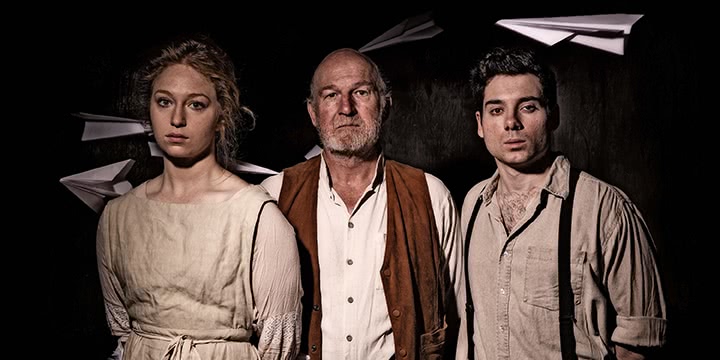
[We Are The Ghosts Of The Future photo by Phyllis Photography]
We Are The Ghosts Of The Future runsFriday November 13 – Saturday November 28 at The Rocks Discovery Museum.